
Can one everyday food change how facial skin ages? One small trial in Los Angeles tested that with a single whole food. Women ate one avocado a day for eight weeks, and the researchers measured how firm and springy their facial skin was before and after. Forehead skin got firmer in the avocado group. Several other measures did not move. This article goes through the trial, what it leaves open about raw food, and how avocado and dates compare on paper. It is general reading, not medical advice.
One avocado a day for eight weeks
Henning and colleagues at the David Geffen School of Medicine, UCLA, published the pilot study in the Journal of Cosmetic Dermatology in 2022 (PMID 35037373). Forty-one women were randomised. Two dropped out, one from each group, and the one in the avocado group left because she no longer wanted to eat avocado. That left 39 women aged 27 to 73, with 20 in the avocado group and 19 in the control group.
To take part, a woman had to have a waist of at least 35 inches, not smoke, have Fitzpatrick skin type II to IV, and eat no more than two avocados a month. The avocado group received a weekly supply and ate one avocado a day. The control group carried on with its usual diet. Both groups were asked to keep their habitual diet and activity level and avoid sun exposure, and no one was to eat avocado outside the study.
How the skin was measured
The team used a cutometer, a probe that sucks the skin up with gentle negative pressure and records how far it stretches and how well it springs back. Readings were taken on the forehead and about an inch below the outer edge of the eye, at the start and at weeks 4 and 8. Hydration, sebum, melanin and redness were measured too. On the inner arm, the team found the smallest dose of UVB light that made the skin turn red.
What changed, and what did not
After eight weeks, forehead skin in the avocado group was firmer and more elastic than at the start. That is the within-group result. Compared directly with the control group, the change in one firmness marker on the forehead was significantly larger in the avocado group. Under the eye, both groups improved on several of the same measures, so the under-eye change was not specific to the avocado group.
Hydration, pigmentation, sebum and the response to UVB light did not differ between the groups. Body weight and body mass index stayed about the same in both groups over the eight weeks.
What the trial does not settle
The authors call it a pilot study with several limitations. They name the choice of facial test sites as one, and they call for longer studies with more women. The age range ran from 27 to 73 and body weight from 59 to 123 kg, and they suggest a narrower range would sharpen any future result. The study was funded by the Hass Avocado Board. The paper states that the authors had no conflicts of interest.
The paper also does not say how the women ate their avocado. So it says nothing either way about raw against cooked. What it does test is one whole food, eaten every day, against a usual diet.
Avocado and dates on paper
USDA FoodData Central (SR Legacy, 2019) gives these values per 100 g. The avocado record is for raw California avocados.
| Per 100 g | Avocado, raw, California | Deglet Noor dates | Medjool dates |
|---|---|---|---|
| Energy | 167 kcal | 282 kcal | 277 kcal |
| Fat | 15.4 g | 0.39 g | 0.15 g |
| Monounsaturated fat | 9.8 g | 0.036 g | no entry |
| Total sugars | 0.3 g | 63.4 g | 66.5 g |
| Fibre | 6.8 g | 8.0 g | 6.7 g |
FDC lists one avocado without skin and seed at 136 g. On these figures, the trial's daily avocado carried about 227 kcal and 21 g of fat, about 13 g of it monounsaturated. A 30 g portion of Deglet Noor dates carries about 85 kcal and 19 g of sugars, with almost no fat. Per 100 g, the avocado has far more fat than sugar, and the dates have far more sugar than fat.
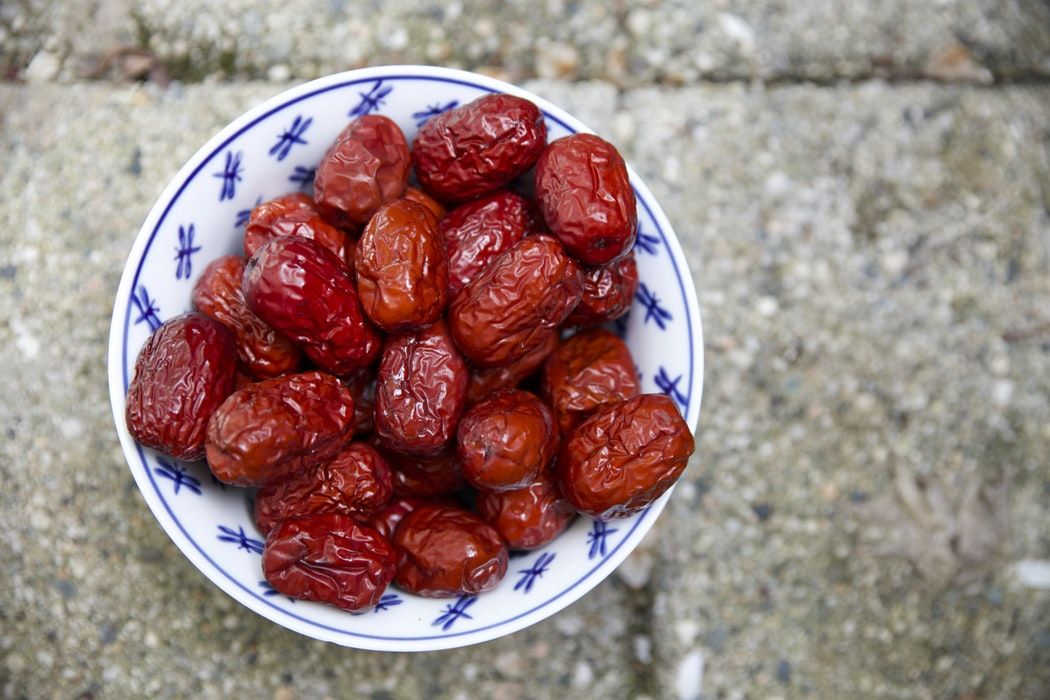
The NHS counts a 30g portion of dried fruit, such as currants, dates, sultanas and figs, as 1 of your 5 A Day. It adds that dried fruit should be eaten at mealtimes, not as a snack between meals, to reduce the impact on teeth. A lunch plate with sliced avocado and a couple of chopped dates puts both foods in one meal.
What the NHS says about sun protection
The trial asked its volunteers to avoid sun exposure, so it did not test food against sunlight. The NHS sun safety page advises spending time in the shade when the sun is strongest and using at least factor 30 sunscreen. It also says: "Do not rely on sunscreen alone to protect yourself from the sun." For another question about food and skin, this site has an article on acne and food.
Readers in Selangor can also look at Pembekal Kurma Selangor. More about this site is on the About Us page and the contact page.