

This article is general information, not medical advice. If you have high blood pressure or kidney disease, or take blood pressure medicine, talk to your doctor before changing your diet.
Diet matters for blood pressure, and dates come up often in that conversation because they are rich in potassium. As a dates supplier, we get asked whether dates can lower blood pressure. This article looks at what dates contain, what potassium and magnesium do in the body, and what the trials on dates themselves found. The short answer: dates fit well in a diet aimed at healthy blood pressure, but no trial has shown that eating dates lowers blood pressure on its own.
What dates contain

Dates are mostly sugar, with useful amounts of fibre and minerals. Per 100 g, Medjool dates have 277 kcal, 6.7 g of fibre, 696 mg of potassium, 54 mg of magnesium and just 1 mg of sodium. Deglet Noor dates have 656 mg of potassium, 43 mg of magnesium and 8 g of fibre (USDA). One Medjool date weighs about 24 g, so three of them give roughly 500 mg of potassium and 39 mg of magnesium. Adults need 3,500 mg of potassium a day, and 270 mg (women) to 300 mg (men) of magnesium (NHS). Three dates therefore cover about a seventh of the potassium and around 13 to 14 percent of the magnesium.
Potassium, sodium and blood pressure
Most people eat too much sodium and not enough potassium. WHO advises adults to have less than 2,000 mg of sodium (5 g of salt) and at least 3,510 mg of potassium a day, and warns that high sodium with low potassium can raise blood pressure, a major risk for heart disease and stroke. WHO names dates among potassium-rich fruits. That is the real link between dates and blood pressure: they are high in potassium and almost free of sodium. The popular claim that the potassium and magnesium in dates "work together" to lower blood pressure has not been tested. Each mineral has been studied on its own, mostly as supplements, and those results are below.

What potassium does
Potassium helps control the balance of fluids in the body and helps the heart muscle work properly (NHS). A WHO-led review pooled 22 randomised trials: eating more potassium lowered systolic blood pressure by 3.49 mmHg and diastolic by 1.96 mmHg on average. The effect showed up in people with high blood pressure, not in people whose blood pressure was normal (Aburto 2013). Those trials raised potassium from many sources, not from dates. Dates are one good source, next to the bananas, vegetables, beans, nuts and fish on the NHS list. If you have kidney disease, check with your doctor first, because people with chronic kidney disease can build up too much potassium in the blood (NHS).
What magnesium does
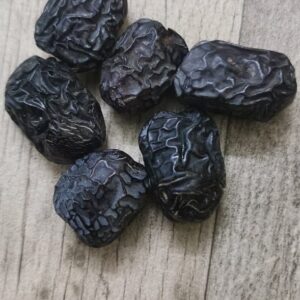
The NHS says magnesium helps turn food into energy and keeps the parathyroid glands, which make hormones for bone health, working normally. On blood pressure, a meta-analysis of 34 placebo-controlled trials found that magnesium supplements, at a median of 368 mg a day for about three months, lowered systolic pressure by 2.00 mmHg and diastolic by 1.78 mmHg (Zhang 2016). Three Medjool dates give about 39 mg, roughly a tenth of that dose. You will also read that magnesium in dates works as a "natural calcium channel blocker" or calms inflammation in the arteries. No study of dates has measured either, so we leave those claims out.
Fibre, cholesterol and what the date trials found
Dates have 6.7 to 8 g of fibre per 100 g (USDA). The NHS says eating plenty of fibre is associated with a lower risk of heart disease and stroke, and recommends 30 g a day. Studies of dates themselves are small. In a pilot study, 10 healthy adults ate 100 g of dates a day for four weeks. Their total, LDL and HDL cholesterol did not change, triglycerides fell by 8% (Medjool) and 15% (Hallawi), and oxidative stress dropped after Hallawi dates but not Medjool (Rock 2009). Blood pressure was not measured. In a 12-week trial, 79 people with type 2 diabetes ate 60 g of dates or raisins a day, and blood pressure, cholesterol and CRP (a marker of inflammation) did not change (Butler 2022). A 2025 review is more hopeful and reports lower blood pressure with moderate date intake in clinical studies, but its authors say standardised human trials are limited and call for larger randomised studies first (Jim 2025). Dates are a good food. Calling them a "superfood for heart health" goes further than the trials do.

What this means for dates suppliers
Customers do ask about health, and a supplier can answer with real numbers: potassium and fibre per 100 g, calories per date. A variety like the kurma ajwa is best sold on its taste, origin and price, with general nutrition facts, not on a promise that it treats blood pressure.
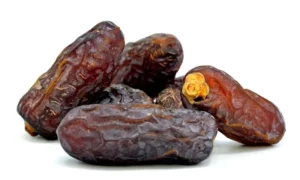
The soft texture and natural sweetness of kurma mariami make it easy to eat every day, which is a fair selling point on its own. Telling customers plainly what dates can and cannot do earns more trust than a cure claim, and it keeps the seller clear of health claims nobody can back up.
How to eat dates with blood pressure in mind
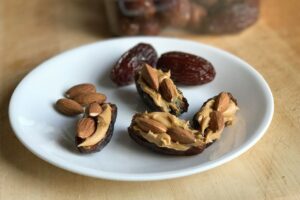
Dates are easy to add to meals. Chop two or three into morning oats, blend them into a smoothie, or stuff one with an almond or walnut as a snack. They can replace some of the sugar in baking, but they are still sugar, at 277 kcal per 100 g for Medjool (USDA). Watch the portion if you are watching your weight, since being overweight is one of the risk factors WHO lists for high blood pressure, along with a high-salt diet. The NHS also names a diet high in salt as a risk, so swapping a salty snack for two or three dates is a small, sensible change. Dates do not replace blood pressure medicine. If you take tablets, keep taking them and talk to your doctor before making big changes to your diet. The kurma medjool palestine, often sold as a gourmet item, is the Medjool variety, so the USDA Medjool figures above apply to it.
The bottom line
Dates are high in potassium and almost free of sodium, and eating more potassium lowers blood pressure in people with hypertension. That makes dates a sensible part of a diet for healthy blood pressure. What has not been shown is that dates themselves lower blood pressure: the controlled trial that measured it found no change, and the more positive review asks for larger trials first. Eat them as part of a balanced, lower-salt diet, keep the portion to a few dates, and leave treatment to your doctor.
References
- Aburto NJ et al. Effect of increased potassium intake on cardiovascular risk factors and disease: systematic review and meta-analyses. BMJ. 2013;346:f1378. PMID 23558164
- Zhang X et al. Effects of magnesium supplementation on blood pressure: a meta-analysis of randomized double-blind placebo-controlled trials. Hypertension. 2016;68(2):324-33. PMID 27402922
- Rock W et al. Effects of date (Phoenix dactylifera L., Medjool or Hallawi variety) consumption by healthy subjects on serum glucose and lipid levels and on serum oxidative status: a pilot study. J Agric Food Chem. 2009;57(17):8010-7. PMID 19681613
- Butler AE et al. Effect of date fruit consumption on the glycemic control of patients with type 2 diabetes: a randomized clinical trial. Nutrients. 2022;14(17):3491. PMID 36079749
- Jim EL et al. Nature's cardioprotective sweetness: a review of dates as functional food in hypertension. Foods. 2025;14(24):4208. PMID 41464915
- USDA FoodData Central: Dates, medjool (FDC 168191); Dates, deglet noor (FDC 171726)
- WHO: WHO issues new guidance on dietary salt and potassium (2013); Hypertension fact sheet
- NHS: Vitamins and minerals: others (potassium, magnesium); How to get more fibre into your diet; High blood pressure; Chronic kidney disease: treatment