
If you typed "Sayer dates 10kg carton" into a search bar, you may be pricing a bulk order. This page covers the parts of that order you can actually check before money changes hands: how much a bulk box of dates normally weighs, what 10 kg of a comparable Iranian date cost on one Malaysian price list this month, and what the label on an imported pack has to show.
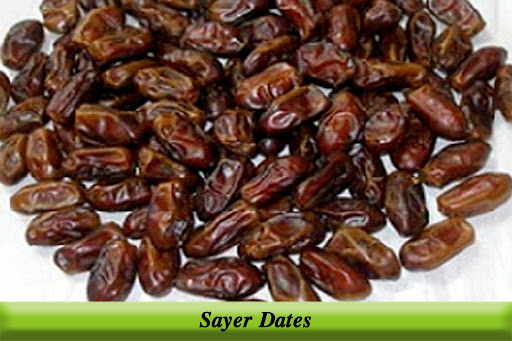
First, the fruit. Sayer is an amber-brown, semi-dry date from Khuzestan in Iran, and it is also traded as Stamaran. It is not Shahani, which is a separate variety. FAO's handbook on date palm cultivation calls it "the Iraqi variety Sayer", so published sources do not all tie it to one country. That is a good reason to ask for the country of origin in writing. Malaysia has no commercial date-growing trade, so any Sayer you buy here has been imported.
Is 10 kg one box or two?
Start with the weight, because it decides how the order arrives. FAO's chapter on harvesting and packinghouse management describes the bulk pack plainly. Dates are "usually packed in cardboard boxes", sometimes with a plastic bag inside for extra protection and to hold moisture. "The usual weight is 5 kg or 15 lbs", depending on where the fruit was grown or where it will be sold.
The same chapter does describe a 10 kg box, but only one. It is a long cardboard box holding two bunches of Deglet Nour on the branch, with a total weight of 10 kg. Nothing in that chapter gives 10 kg as a standard weight for bulk dates.
So when a quote says 10 kg, ask the obvious question. Is it one box, or two 5 kg boxes sold together? Either can be fine. You just want to know before the delivery arrives, so you can check that the weight on each label adds up to what you paid for.
On the Malaysian list checked for this page, no listing weighed 10 kg at all. The heaviest was an 8 kg Medjool listing made of eight 1 kg packs, and it was out of stock. Every 10 kg figure below is therefore built from smaller packs.
Pricing a Sayer dates 10kg carton against Mariami
On 28 November 2026 we read one Malaysian wholesaler's live price list. It had 58 date listings, 23 of them in stock, and not one was called Sayer or Stamaran. Those prices belong to that wholesaler, not to this site, and they will move with stock and promotions.
The nearest match is Mariami. Like Sayer, it is an Iranian date, and it is described as dark, semi-dry and chewy. It is not the same fruit, so treat the figures as a yardstick for a Sayer quote, not as a Sayer price. Here is what 10 kg of each Mariami listing that comes in 1 kg or 5 kg packs would have cost.
| Mariami listing | Pack price | Packs for 10 kg | Cost of 10 kg | Stock on 28 Nov 2026 |
|---|---|---|---|---|
| Mariami A no.2, 5 kg | RM68 | 2 | RM136 | Out of stock |
| Mariami A Normal 2026, 5 kg | RM75 | 2 | RM150 | In stock |
| Mariami AA (No.2), 5 kg | RM80 | 2 | RM160 | Out of stock |
| Mariami AA 2026, 5 kg | RM129 | 2 | RM258 | In stock |
| Mariami AAA VIP 2026, 5 kg | RM148 | 2 | RM296 | In stock |
| 1kg Mariami AAA | RM40 | 10 | RM400 | In stock |
The list had three more Mariami listings: a 6 kg box of twelve 500 g packs and two pouch listings that each total 4.8 kg. All three were out of stock, and none of them adds up to 10 kg cleanly, so they are left out of the table.
Among the packs you could actually order that day, 10 kg ran from RM150 to RM400. The low end is two 5 kg packs of A Normal. The high end is ten 1 kg AAA packs. If you want a per-kilo comparison across more varieties, the October round-up of wholesale date prices walks through the listings under RM20 a kilo from an earlier check of the same kind.
Ten small packs or two big ones
The last row of the table is the one to look at twice. Ten 1 kg packs of Mariami AAA came to RM400. Two 5 kg packs of Mariami AAA VIP came to RM296. The labels are not identical, since one says VIP and the other does not, so this is not a like-for-like grade test. On this list, the ten small packs still cost RM104 more than the two big ones.
For a Sayer quote the lesson is simple. Ask for the price of the 10 kg as it is packed. A price for 10 kg in small packs and a price for a plain bulk box are two different things, so compare like with like. Our page on working out a fair Sayer quote per kilo goes further into turning any quote into a figure you can line up against others.
Why a date that dries on the palm suits a bulk box
FAO names Sayer among the varieties that are mostly harvested "after the fruit has undergone the process of ripening and drying on the palms". That puts it at the tamar stage when it is picked. FAO calls tamar fruit non-perishable, meaning micro-organisms cannot grow on it. The same sentence warns that moisture uptake, and changes in colour and taste, still happen during storage.
The handbook also notes that much of the fruit is marketed throughout the year, "especially fruit at the Tamar stage". Compare that with FAO's description of the fruit's growth stages, which says dates at every stage except tamar are perishable "due to their high water content". A bulk order of tamar fruit is not a licence to forget about it, though. FAO points out that "cardboard is sensitive to humidity", and a 10 kg order in cardboard sitting on a damp floor is the kind of risk you can avoid for free.
Sayer shares that FAO sentence with Zahidi, another date picked after drying on the palm. If you also buy dry dates of that kind, this guide to the questions worth putting to a Zahedi supplier covers hydration and storage in more depth.

What the label on a 10 kg order should show
Malaysia's food labelling guideline from the Ministry of Health (Garis Panduan Pelabelan 2023) lists what has to appear on a food label. Regulation 11(1)(i) asks for the net weight. Under regulation 11(1)(j), an imported product must carry the name and address of the importer and the country the food came from.
FAO's list for export packaging goes a little further. It asks for the net weight, the country of origin, who grew and packed it (with an address), the product and variety, and the category or grade. FAO also says that in most importing countries the law demands weight, country of origin, quality and expiry date on the package.
For a 10 kg order, that gives you a quick test when it lands. If it came as two boxes, each one should state its own net weight, and the two should add up to 10 kg. FAO's export list includes a variety line, so ask for one that says Sayer or Stamaran rather than just "dates". And the country of origin should match what you were told when you ordered.
Questions to send before you pay
Ask whether the 10 kg is one box or two, and what each box weighs. Ask which country the lot came from, given that sources differ on where Sayer is grown. Ask for the grade name the packer uses, because A, AA and AAA are each importer's own sorting and do not mean the same thing everywhere. And ask for the price as packed, so you are not comparing a bulk box with ten repacked 1 kg packs.
If you are still choosing who to buy from, our longer guide to choosing a Sayer dates supplier covers names, grades and paperwork. For ordering without a shop visit, the piece on buying dates online in Malaysia is a useful companion.
Short answers
Is a "Sayer dates 10kg carton" a standard pack?
Not according to FAO's packing chapter. It gives 5 kg or 15 lb as the usual bulk weight, and the only 10 kg box it describes holds two bunches of Deglet Nour on the branch.
What did 10 kg of a comparable date cost?
On one Malaysian list checked on 28 November 2026, 10 kg of Mariami cost RM150 to RM400 among the packs in stock. No Sayer listing was on that list.
Is Stamaran a different date?
No. Stamaran is another trade name for Sayer. Shahani is the one that is a different variety.
Before you agree to a "Sayer dates 10kg carton", get the box count, the net weight per box and the country of origin in writing. Net weight and country of origin are both things the label on an imported pack has to carry.
More about this site is on the About Us page and the contact page.