
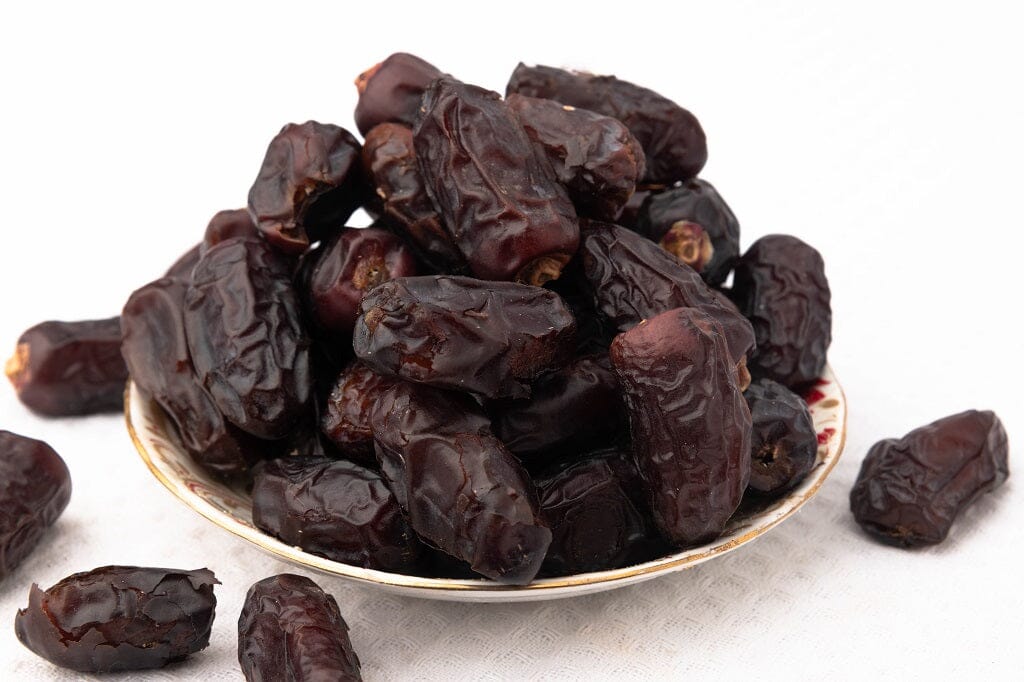
The first thing most people notice about Kurma Safawi Malaysia is the colour. It is close to black, and the skin is smooth rather than deeply wrinkled like Ajwa. Safawi grows around Madinah in Saudi Arabia, the same region as Ajwa, yet the two eat quite differently. This piece is about that flavour and about how to serve Safawi so the flavour actually comes through: on a plate for guests, next to a cup of coffee, and in the kitchen.
What Safawi tastes like, in plain terms
The flesh is thick, soft and meaty, and the sweetness is moderate. It is sweet without being sticky, so it does not leave syrup on your fingers. That moderate sweetness is the whole character of the date. Ajwa is smaller, and its sweetness is lighter and more aromatic. Safawi feels fuller in the mouth because there is more flesh around the seed.
If you want something intensely sugary, look elsewhere. If you want a date you can eat a few of in one sitting without it turning cloying, Safawi fits.
Serve it at room temperature
Straight from the fridge, Safawi is firmer and the sweetness comes across muted. Take out what you plan to serve about half an hour ahead and let it warm up on the counter. The flesh softens again and the taste opens up.
For storage, Green Diamond's own guidance is a cool, dry spot away from direct sun, with an airtight container once the pack is opened. They give up to 6 months at room temperature and up to 12 months in the fridge. In a humid Malaysian kitchen the fridge is the safer choice for anything you will not finish within a few weeks. Just remember the half-hour rule before serving.
Pairings that suit a moderate sweetness
Because Safawi is not overly sweet, it pairs well with things that are bitter or salty. A few that work:
- Black coffee or teh O kosong. Across the Gulf, dates are served with Arabic coffee, and the bitter cup against the sweet date is the point.
- A whole almond or a walnut half pressed into a pitted date. Safawi has enough flesh to close around the nut.
Small cubes of a sharp cheddar on the same plate also work, if your guests like a salty contrast.
Savoury cooking is another option. Chopped dates go into slow-cooked lamb or chicken, and our notes on cooking dates with meat cover a few ways to add them.
Using Safawi in the kitchen
Soft flesh means Safawi blends easily. Pit a few into a banana smoothie, mash them into a paste for date balls rolled in desiccated coconut, or chop them over oats. Always pit by hand first and check each one. A stray seed in a blender is an expensive mistake.
The same ideas work with other soft varieties. If you have Mariami in the cupboard as well, these ways to cook with Kurma Mariami AA carry over to Safawi with little change.
Does the grade change the taste?
Not much. Safawi is graded A, AA and AAA Jumbo, and the grade is set mainly by size and how even the fruit is. A bigger date gives a bigger bite, but the flavour is the same variety. For stuffing with nuts or putting on a guest tray, the larger grades are easier to handle and look neater. For blending or baking, grade A does the job.
Where suppliers really differ is in sorting. Some take the time to sort and grade carefully so they deliver dates that meet customers' size expectations. Others mix sizes inside one box. Before ordering a large quantity, ask for a photo of the actual batch.
Where to go next
Safawi is one variety among many. If you are comparing it with Mariami, Medjool and Deglet Nour, our overview for date enthusiasts deciding whether to buy online is a sensible next read. For Safawi specifically, see our page on premium Kurma Safawi.